After a Tooth Extraction How Lon Before Your Mouth Feels Right Again
All topics. » All Molar Extraction pages. » Timeline of extraction site healing.
Tooth extraction healing timeline. – Appearance changes and stages of extraction site healing. (The first-24 hours post-op to iv weeks and beyond.)
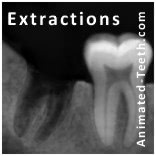
X-ray of an empty tooth socket.
How long does it take for a molar extraction site to heal?
Once your tooth's extraction procedure has been completed, you lot'll no dubiety want to know how long it volition accept for its socket to heal and what it should look similar every bit it does.
So to provide an answer to these questions, we've broken this page'south discussion into the following time frames and stages:
- A) What you'll notice during the initial 24 hours following your surgery.
- B) Healing progress during weeks 1 & 2.
- C) Healing progress during weeks 3 & iv.
- D) Bone tissue healing timeline (Details nigh how long it volition accept the hole in your jaw to fill up in and close.)
Additional issues associated with the extraction healing procedure.
Since they're closely related subjects, we as well accost the following questions on our website:
► How much fourth dimension volition you need to accept off later on your extraction?
It merely makes sense that you'll need to know how long you may need to take time off or limit your activities subsequently having your molar pulled. Jump to page.
And while it is your dentist who is actually in the best position to know, our page explains what factors tin can touch what you'll cease up needing to practise.
► When can future dental work be started?
In the example where a tooth that's been pulled will need to be replaced, we explain how extraction site healing will impact the timing of this future dental work. Jump to department.
Things you'll need to go along in mind while reading this page.
Wound size matters.
While the type of healing events that have taken place at any point in time volition exist similar for all extractions, it's important to keep in heed that more than involved (larger, deeper, wider) wounds simply take longer to heal over and fill in than comparatively smaller ones.
So, for example, that means if you've had a major procedure performed, like having a wisdom molar surgically removed, y'all'll need to await that the full corporeality of healing time it requires will be greater than that needed for less involved extractions, like having a lower incisor or a baby tooth pulled.
Personal factors come up into play too.
It'southward important to keep in mind that the healing capacity of individuals varies. This is in part due to their differing genetic characteristics simply too includes factors associated with the person's current status, such as age, medical condition, and personal habits (due east.grand. smoking).
The preoperatory status of a tooth will besides influence its extraction site'south healing timeline. For example, pathology associated with a molar at the time of its removal, like the presence of infection due to gum illness, pericoronitis (infection around an impacted molar), or endodontic status (teeth having infected nerve tissue) can prolong or complicate the healing procedure.
▲ Section references – Cohen
The stages of extraction site healing –
A) The initial 24 hours following your tooth extraction.
What tooth sockets look similar immediately following the extraction process.
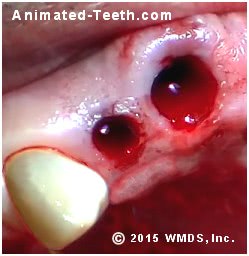
Blood clots have begun to form and fill in the sockets.
What will you discover? / What volition your extraction site look like?
The amount of healing progress that you'll be able to visualize during the first 24 hours subsequently your surgery won't await like much. Just what has taken place is vitally important.
a) During the beginning 24 hours following your extraction, you should detect that …
- A blood jell has filled the molar's empty socket. (Information technology's the clot's formation that actually triggers the healing procedure.)
- And the bleeding from your wound has stopped. If not …, in cases where bleeding persists, information technology interferes with the germination of tissues that are needed for the healing process to progress.
b) Also during the first 24 hours …
- You'll hopefully observe that the level of any discomfort associated with your extraction site has begun to slowly subside.
- You'll probably observe that the region immediately side by side to the empty socket is tender when touched.
- Traumatized gum tissue immediately surrounding your socket may accept a whitish appearance.
- It's possible (especially in the example of a relatively involved or difficult extraction) that you'll find some degree of swelling has already started to form, both in the tissues that surround your extraction site and perhaps your confront as well.
If so, this swelling should peak inside the first 48 to 72 hours and and then beginning to subside. What to look. / Management.
What's taking identify with the mucilage tissue around your extraction site at this phase?
While you won't really be able to notice anything, the creation of new mucilage tissue around the edges of your wound has already begun. This starts every bit early every bit 12 hours post-extraction.
What's going on inside your tooth's socket?
Immediately following your tooth's extraction its socket volition fill up with claret and the germination of a clot will brainstorm. The blood clot typically fills the socket upwards to the level of the gum tissue surrounding it.
The jell itself is equanimous of platelets (viscid cell fragments that initiated the clot's formation) and reddish and white claret cells, all embedded together in a fibrin gel. (It'southward the fibrin gel that gives the clot its semi-solid consistency.)
Starting at this signal, and continuing on during the days that follow, the platelets in the jell, along with other types of cells that take been attracted to it, begin to produce chemical compounds that initiate and advance the healing process.
▲ Section references – Farina, Politis, Cohen
How long does the blood clot last after a tooth extraction?
What happens to the blood clot that forms later a tooth is pulled? / When does information technology get away?
These aren't such cutting and dried questions to answer because during the healing procedure the clot isn't specifically lost or discarded. Instead, over time, information technology's infiltrated by other types of cells and newly forming tissues.
In essence, it becomes the scaffolding for all of the participants of the healing process to follow. So that means that the blood clot that fills in the molar'south socket after an extraction isn't so much "lost" as information technology is "transformed."
On this page, in each healing period's "What's going on inside your tooth'southward socket?" department, we depict the transformation that'south taking identify at that betoken.
Restrictions on activities. / Taking time off.
During this initial 24-hr flow following your extraction, y'all may offset to wonder how much full time yous should take off for rest and recovery.
What'southward needed.
As anyone would probably anticipate, the specific circumstances associated with your procedure volition exist one determining factor.
- With routine extractions ("simple" extractions) … it's mutual for a patient to accept the balance of the day off.
Although, with the easiest of these types of procedures (small teeth, unchallenging removal), but a few hours of recuperation followed by a low-cal schedule may be sufficient.
- With difficult or involved extractions (impacted wisdom teeth or other "surgical" extractions) … you lot may demand to accept off a few days, once over again, depending on the specifics of your process.
Of course, a patient'southward personal factors (like their age or general health status) volition need to be considered too.
Your all-time resource.
It is, of course, your dentist who'south in the all-time position to estimate what you'll require. And it'due south their obligation to advise you accordingly. And then, if they don't, just enquire (or telephone call dorsum and inquire).
If you'd like more information well-nigh this subject, we offering this folio: How much fourth dimension do you demand to take off after a tooth extraction? Jump to folio.
Tooth Extraction Healing pictures – The stages.
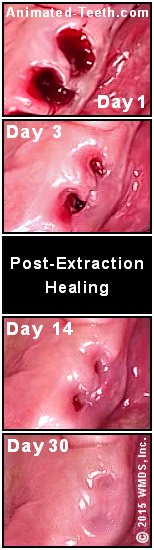
What a tooth extraction site looks like during healing, day 1 to 4 weeks.
B) Extraction site healing – Weeks one and 2.
What volition you notice? / What volition your extraction site await like?
During the get-go two weeks following your surgery, you should find that the mucilage tissue that surrounds your extraction site has completed a significant corporeality of repair.
- Equally compared to the skin on the outside of your body, wounds located in the soft tissues of the rima oris tend to heal more than quickly.
- As a point of reference for how much repair has taken identify at this stage, it's usually considered that enough gum tissue healing has taken identify by days vii through x that stitches tin can be removed. How that's done.
(Removing stitches ways that the healing tissues are now strong enough and anchored to the underlying os securely plenty that the stabilizing outcome that the stitches provided is no longer required.)
Especially towards the cease of this time frame, your extraction area should look much improved. (Pinkish equally opposed to reddish. Rounded tissue contours.) It shouldn't pose whatsoever significant inconveniences (tenderness, bleeding, etc…) or concerns.
How much volition the socket have closed?
The total amount of healing that's been able to take place by this indicate in fourth dimension (weeks 1 & 2) will be influenced by the initial size of your wound.
- The sockets of smaller diameter, single-rooted teeth (such as lower incisors) may appear generally healed over by the end of two weeks. The same goes for infant teeth.
- Wider and deeper wounds left past comparatively larger teeth (canines, premolars) or multi-rooted ones (molars), or wounds resulting from surgical extractions (like needed to remove impacted wisdom teeth), will require a greater corporeality of time to heal over and show signs of filling in.
So in these types of instances, the contours of the gum tissue in the region may still bear witness quite an indentation or divot in the expanse of the tooth'south socket.
What's going on within your tooth'south socket during this fourth dimension frame?
During the first calendar week after your extraction, the claret jell that originally formed in your tooth's socket will accept become partially colonized (it's in the process of being fully replaced) past granulation tissue. This is a primordial blazon of tissue that's rich in collagen (an important tissue building-cake protein) and developing blood vessels.
Toward the end of this time catamenia, and as a next phase, mesenchymal cells ("developed" stalk cells) volition begin to class a dense network within this granulation tissue (and later on fully replace it). These cells will ultimately differentiate into more than specialized types of cells, such as bone tissue.
▲ Department references – Cohen, Farina
Restrictions on activities.
Since the new tissues that form during this fourth dimension frame are quite vascular in nature (they contain a large number of blood vessels), if you traumatize your extraction site it's likely to drain hands. So be careful when eating foods or brushing. You lot can also expect this new tissue to be tender if touched or prodded.
Merely other than that, and particularly towards the end of this two-calendar week period, you should find that your extraction surface area is of minimal concern and does not need to exist a major consideration in regard to performing routine activities.
C) Extraction site healing – Weeks 3 and iv.
What will you detect? / What will your extraction site look like?
By the end of the 3rd to 4th weeks afterward your molar extraction, well-nigh of the soft tissue healing will have taken identify.
- Y'all'll probably all the same exist able to see at least a slight indentation in your jawbone that corresponds with the molar's original socket (pigsty).
- Where a large tooth (tooth) or several teeth in a row have been removed, or with cases where a significant amount of os was removed during the extraction process (like with impacted wisdom teeth), a relatively significant indentation may still remain. It may persist, even for some months.
What'southward going on inside your tooth's socket at this point?
During this stage, mesenchymal cells will go along to proliferate into the socket'southward granulation tissue and organize into a dense network. At this point, they'll have replaced well-nigh half of the granulation tissue that originally formed.
Many of these mesenchymal cells volition transform into bone cells, and they will brainstorm to create the socket'south first new os tissue. This new bone growth takes place side by side to the existing walls of the socket, which means that it will fill in from the bottom and sides (every bit opposed to across the top). This explains why tooth sockets become narrower and more shallow every bit they heal.
▲ Section references – Pagni, Cohen
Restrictions on activities.
You may find that the new gum tissue that has formed has some tenderness, like when jabbed by hard foods. But at this signal, even this level of trauma probably won't crusade any significant amount of haemorrhage.
D) Bone healing – Filling in the socket.
How long does information technology take the hole to close after a tooth extraction?
After y'all've had a molar pulled, it's the healing of the hole in your jawbone (the tooth's socket) that takes the greatest amount of time (as opposed to your gum tissue).
- New bone formation actually doesn't showtime to brainstorm until the stop of the kickoff week mail-op.
- After about viii to 10 weeks, your tooth's extraction socket (the hole) will have substantially filled in with newly formed bone. (Around two/3rds of the way.)
- At around 4 months, the socket volition be completely filled in with new bone.
- It then takes on the guild of another 2 to iv months (6 to 8 months post-op) of further healing for the extraction site to finally finish smoothing out evenly with the contours of the surrounding jawbone.
- During the whole procedure, the newly formed bone gradually matures and becomes denser. It finally reaches a density similar to that of the surrounding jawbone at around 4 months (as demonstrated past 10-ray evaluation).
So in terms of the extracted tooth's hole filling in to the indicate where your surgical site no longer shows much of an indentation where your tooth used to be, the corporeality of time required will be on the society of 4 months plus.
▲ Section references – Politis, Pagni, Cohen
What will you notice as the bone fills in?
Initially.
During the initial weeks following your extraction, it will be easy for yous to see and feel the pronounced hole left in your jawbone.
In some cases, information technology may exist deep enough that information technology traps food and debris. (Especially large or deep sockets may crave "irrigation" (gentle flushing out) When. How to. to keep them clean during the early on weeks of healing.)
As the healing process progresses.
The formation of new os first starts adjacent to the bony walls of the molar's socket, which means that as the healing process progresses the socket will fill up in from the bottom and sides first.
In terms of appearance, that ways that over time the width and depth of the wound will become more narrow and shallow. What once was a pigsty will gradually transform into less of ane, and then just a divot, so a dimple, ultimately smoothing out and blending in with the contours of the surrounding bone.
A healed extraction site.
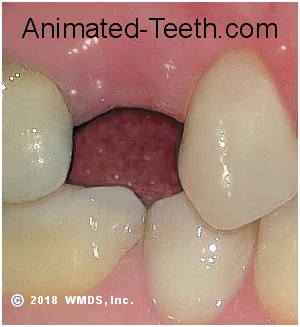
Annotation the sunken appearance of the bone (in both acme and thickness) due to ridge resorption.
The shape of your jawbone will modify.
While the contours of your tooth's extraction site will ultimately fill in and shine out, the shape of your jawbone in the immediate expanse will undergo permanent changes.
Jawbone pinnacle.
Some of the bone'south original acme will be lost during the healing procedure. Resulting in a saddle shape where its lowest betoken is definitely lower than where it originally lay on the extracted tooth.
Jawbone width.
There will also be a reduction in the width of the jawbone in the area of the healed socket. Usually this loss is greater on the cheek or lip side, as opposed to the palate or tongue side.
Studies take shown that the dimensional changes associated with premolar and molar extraction healing tin can run as loftier every bit 50% of the bone's width at 12 months mail service-op.
Together, these changes in bone dimensions give a healed extraction site a sunken-in look (see motion-picture show).
▲ Section references – Walker, Pagni
Ridge resorption.
The tiptop and width changes mentioned to a higher place are collectively referred to as "resorption of the alveolar ridge" (the alveolar ridge is that portion of a jawbone that holds its teeth).
One long-term report (measurements were taken 2 to three years mail-extraction) reported alveolar ridge shrinkage on the club of 40 to 60%. (Pagni – Linked above)
How long exercise these changes have?
The corporeality of fourth dimension it ultimately takes for bone healing, and thus for the "terminal" shape of the ridge to form, will profoundly depend on the size of the original wound. Larger wounds (i.e. multi-rooted teeth like molars, surgical sites from impacted wisdom tooth removal) will accept longer to heal and will effect in a greater degree of alveolar ridge changes.
- Overall, the rate of resorption (and therefore os shape changes noticed) will exist greatest during the outset month post-op.
- At 3 months, 2-thirds of the changes will take occurred. By 6 to 12 months out, the majority of the transformation will have been completed.
- Across that, some level of connected resorption will continue throughout the patient's lifetime, admitting at an ever reducing charge per unit (estimated around 0.5 to 1.0% per year).
▲ Section references – Wan der Weijden, Schropp, Pagni
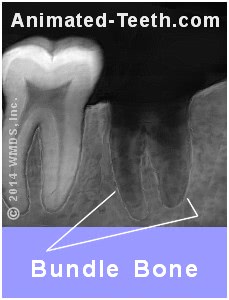
Immediately subsequently an extraction, the outline of the socket is easily seen.
FYI: Bundle Bone
If your dentist would take an 10-ray immediately subsequently pulling your tooth, it would bear witness a white line outlining the shape of your tooth'due south socket (see our graphic).
This is termed "bundle os" and it'southward the layer of bone in which the fibers that anchored your tooth in place (its periodontal ligament) were embedded.
Since the tooth is now gone and this outline of bone no longer has a office, as the healing procedure progresses and new bone is formed, this layer will be gradually resorbed (be broken down and dispersed past your body).
Afterwards near 18 months or so, information technology volition accept totally disappeared and the outline of the socket volition have been mostly lost.
Restrictions on activities.
As significant equally the changes that take place are, it's really a dull gradual process that during the six to eight months that information technology takes, you really won't find anything going on at all.
$.25 and fragments.
The exception might exist the case where yous discover a modest piece of broken tooth or necrotic bone poking through the surface of your gums (your body's attempt to eject the object).
In most cases, these fragments are only of minor business organization and are easily removed. This link explains in greater detail: Managing bone and tooth fragments. What to exercise.
Treatment timing – Making plans to replace your missing tooth.
The fact that it takes as long as 6 to 12 months for the majority of the jawbone'south healing process to take place doesn't mean that you have to wait that long until your empty space tin be filled in with a replacement tooth.
A healing menstruum may be needed.
With some types of restorations (dental bridges, partial dentures, some kinds of dental implants) there is typically a healing 'wait' menses that must be adhered to for best results. For many cases, this may exist on the gild of just 1 to a few months. With others, it may be half-dozen months or longer before the last prosthesis should be placed.
The general idea is that the dentist wants to await for your socket's healing procedure to have progressed to a point where the changes it creates in the shape of the jawbone (see discussion above) won't substantially adversely affect the fit, part, or appearance of the replacement teeth.
Simply even if some sort of wait period is required, your dentist should accept some type of temporary tooth or appliance that tin can be placed or worn until that point in fourth dimension when your jawbone'southward healing has advanced plenty.
Our adjacent folio discusses post-extraction recovery and care the solar day afterwards and beyond. ►
Page references sources:
Cohen N, et al. Healing processes post-obit tooth extraction in orthodontic cases.
Farina RT, et al. Wound healing of extraction sockets.
Pagni G, et al. Postextraction Alveolar Ridge Preservation: Biological Ground and Treatments.
Politis C, et al. Wound Healing Problems in the Mouth.
Schropp L, et al. Bone Healing and Soft Tissue Contour Changes Following Single-Tooth Extraction: A Clinical and Radiographic 12-Month Prospective Study.
Van der Weijden F, et al. Alveolar os dimensional changes of post-extraction sockets in humans: a systematic review.
Walker C, et al. Evaluation of Healing at Molar Extraction Sites With and Without Ridge Preservation: A Randomized Controlled Clinical Trial.
All reference sources for topic Tooth Extractions.
Comments.
This section contains comments submitted in previous years. Many have been edited and so to limit their scope to subjects discussed on this folio.
Comment –
Gum healing.
I had my wisdom teeth removed ii weeks agone and everything it fine with their healing only the tooth in front of a socket on the bottom has a flap of mucilage on the outer side. Will it become dorsum to normal on its own or will the dentist accept to practise something? Information technology's not infected every bit far as I can tell.
Anonymous
Answer –
You should call you lot dentist and describe your state of affairs and let them make a determination.
In routine cases, over time (several weeks) the expectation would be that your trunk will just take intendance of the excess flap of tissue on its own. The tissue will slowly shrink down and ultimately smooth out.
In cases where the dentist feels that the backlog is somewhat sizable, they may trim it for the patient, so to speed things along and to ensure an ideal last tissue contour (one that doesn't trap debris or interfere with brushing and flossing).
Staff Dentist
Annotate –
White areas in hole where tooth removed.
There is white/creamy areas in the center of the hole where both lesser molars were removed. Is this normal? Tin can I rinse with annihilation other than salt h2o to remove it?
Kerrie
Reply –
Information technology would take evaluation past your dentist to know for sure merely what you find is probably just the normal appearance of the tissues as the healing process advances (new tissues forming, clot disintegrating).
You lot don't say how many days ago you had your teeth removed as at that place are different rinsing instructions for the first day vs. the following ones (see buttons at top of this page).
The less you do, probably the better. The use of liquids other than just saltwater are likely to irritate the wound and typically brand a poor selection.
Staff Dentist
Comment –
Clot
I had a molar pulled a week ago. The socket feels like it is full with I'm guessing is the blood jell. I take been conscientious not to dislodge it. Is the clot captivated or volition it come out or does information technology simply deliquesce? What about what feels like a pare flap that moves slightly with my natural language? Will it die off? Thank you
Marsha S.
Answer –
As discussed above, over time the jell is infiltrated and replaced past other types of cells that are an important part of the healing process and important in the formation of new tissues.
Smallish flaps of gum tissue should disappear (by a procedure termed apoptosis that eliminates unneeded tissues) in the weeks following your process. This is part of the the surgical area'due south "remodeling" process. Large flaps may persist and may need to be removed surgically past your dentist.
Staff Dentist
Source: https://www.animated-teeth.com/tooth_extractions/a-tooth-extraction-healing-times.htm
0 Response to "After a Tooth Extraction How Lon Before Your Mouth Feels Right Again"
Post a Comment